
The Ohio Register on the Question of the Radio-off "Opt Out Meter"
Citizen Journalism is Telling the Truth

On June 29th, I published “BIG NEWS? Two New Stories (of Hope) from the US’s Smart Meters (& De-Evolutionary Dumpster Fire) “Our Revolution Massachusetts”, and Eversource Customers paying a surcharge for opt out meters that transmit RF.
I wrote about a dedicated contingent of Democratic voters in Massachusetts who have demonstrated that they are ready, willing, and able to heed concerns about clean energy, and specifically about smart meters.
The new meters being installed by investor-owned utilities in the Commonwealth will reportedly allow consumers “to see how they are using electricity in real time on their cellphones, so that they can make better decisions.”
What consumers are not being told is that the utility will be collecting, storing, and sharing/selling all of this personal private data - coming to a gas-guzzling/water- hogging data center near you, or even one far away, but still being stored, and oh yes with data also flying through the airwaves.
I also wrote about a communique received from an Eversource customer, where the utility admitted that the opt out meter with the radio off was still transmitting every 20 seconds.
One question that needs to be asked is whether this transmission, which cannot be stopped, is the transmission of private usage data for the component that the two manufacturers have placed in the meters, by default?
In Massachusetts, even customers who have prepaid for electricity at a fixed rate through a municipal aggregation program, often to support a higher contribution from renewables, and who are not candidates for time varying rate structures, are being defaulted into the new meters and the surveillance infrastructure.
(This is similar to the issue I encountered with the modem/router that Comcast/xfinity is providing to customers, without necessarily divulging that it is a network hotspot, or in my case, misrepresenting the product entirely as a hard-wired device capable of being used by a customer requiring protection from wireless exposures.)
The Ohio Register
Today I was reminded of another growing source of strength within the informed community, when I received a link to a recent article by the Ohio Register.
(I am always on the lookout for other publications that we can promote that are providing accurate coverage of wireless issues in other states.)
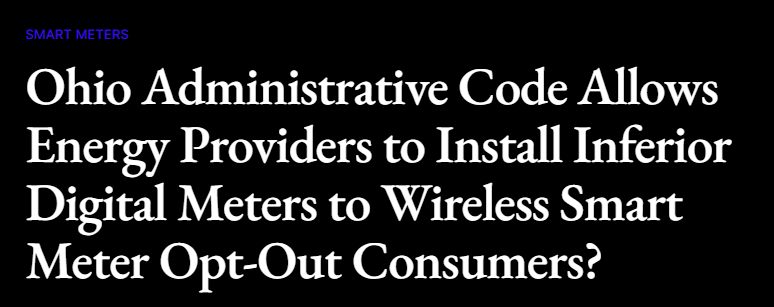
(If you can, please click on their article link to support their work. Publication is a numbers game)
From the Ohio Register
While some utility providers are offering “opt out” programs for consumers willing to pay fees, Ohio Administrative Code 4901:1-10 allows electric providers to install digital meters with the RF turned off instead of traditional analog meters. []
While major utility firms like PG&E, Consumers Energy, and DTE Energy offer programs allowing consumers to disable the RF wireless function for a fee, researchers warn that digital opt-out meters still present risks.
Bill Bathgate, an electrical engineer and utility meter expert, conducted research showing that digital opt-out meters lack the safety profile of traditional analog equipment. The primary concern centers on a component known as a Switching-Mode Power Supply (SMPS). An SMPS is built into digital meters from manufacturers such as ABB, GE, Itron, and Landis+Gyr. The component converts the 240-volt alternating current (AC) from power lines into the low-voltage direct current (DC) needed to run the digital display and internal electronics.
According to engineering assessments, the SMPS conversion process continuously emits high-frequency voltage spikes 24 hours a day. Testing on specific models, including the Silver Springs Network OWS 514 NIC widely deployed by major utilities, revealed the units emit constant millisecond bursts reaching frequencies of 50,000 Hz and higher. _ the Ohio Register
The article hyperlinks to another site that further explains the issue of high voltage transients, (and where readers can also purchase a whole house filter.) (I am not endorsing a very costly solution that is not available to all. The power coming into the home should not be polluted, but I understand how and why these initiatives are being offered, in an impossible dynamic.)
In our on-going investigation into why so-called ‘smart’ meters being installed by PG&E, DTE, Consumers Energy, Duke Energy and many utilities against rising public opposition are causing so many people to be sick, and so many problems with other electric and electronic equipment, we have been fortunate to obtain the advice of electrical engineers.
On examination of typical meters, including ABB, GE, ITRON and Landis+Gyr, and many others they report that, in addition to its RF transmitter, each wireless digital meter also has a component called the ‘switching-mode power supply’ (SMPS) – switching power supply for short. Its function is to ‘step down’ the 240v alternating current (AC) coming in from the utility pole power lines to the 3.3 to 12 volts of direct current (DC) required to run the meter’s digital electronics which record the electricity usage data and send out the various RF transmissions.
The SMPS function emits sharp spikes of millisecond bursts constantly, 24/7. The SMPS on the commonly used Silver Springs Network, OWS 514 NIC model, for instance, which is within the smart meter models widely installed by PG&E and other utilities throughout their territory, has been measured to emit spikes of up to 50,000 Hz and higher. This constant pulsing of high frequencies, in addition to the RF function, is causing not only interference with other electric and electronic equipment in many homes with smart meters installed, but also is causing havoc with biological systems in its field of exposure. (See Wikipedia and Prevention Magazine articles).
In case you missed it, here is a short promotional video about the new data-generating spy component in the meters - from the industry, without mention of the surveillance, and implying that consumers are driving demand:
The Auto-generated Transcript About That Nifty New Electric Meter
“People are changing how they think about and manage their home’s energy resources.
For utilities to be successful they can’t afford to be blind to what’s happening behind the meter.
Sense gives utility customers a new understanding of what’s happening in their home and helps them find ways to control energy costs.
We use high resolution energy monitoring and machine learning algorithms to identify devices in the home and provide detailed insight on how they are being used.
Through the sense app customers get information in real time helping them understand what’s happening right now.
This drives significantly higher customer engagement than applications or reports that provide only an estimate of what happened yesterday or last month.
Customers can also set device alerts for example when the oven is left on too long. create energy goals and respond to rate-based alerts.
The resolution energy data can also help grid operators to pinpoint unpredictable loads to identify and integrate distributed energy resources and to detect voltage and other power anomalies.
Today the sense monitor is installed in the customer’s electric panel and connected to sense cloud through the home’s wi-fi network Sense provides apps for ios android and the web data can also be integrated into utility customer engagement platforms and other back office systems through sense apps.
Now thanks to our partnership with industry leader Landis and Gyr Sense will be built directly into the new Revelo meter bringing the power of our data to customers without the need for additional hardware
To demonstrate this breakthrough technology in our lab we’ve set up a cart equipped with revello meter running sense connected to various resistive and inductive loads that you would find in a typical home
Here we can see sense in action with a griddle heat lamp fan and fridge, the heat lamp is already on, now let’s see what happens when we turn on the 240 volt griddle. The wattage drastically increases and then as we turn it off decreases and disappears. Now let’s see the fan. This technology can be activated on any Revello meter for residential customers with sense on the Revello meter
Utilities can be assured that they are delivering new value to their customers.
Sense data and insights help people and their homes actively participate in a cleaner and more resilient power grid” - Sense for Utilities
(National Grid has also partnered with Sense,)
In case you missed it:
Here is the link to Keith’s post:

Sean discussed how these devices are not traditional meters in the historical sense, but rather networked computing systems capable of detailed data collection. We explored his concerns that residential load imbalances and other issues may introduce billing inaccuracies, that these systems enable remote disconnection of electrical service—potentially without direct human intervention—and that the dirty electricity generated by the meters themselves may even influence their measurement accuracy. He also explained how homeowners can identify whether they have the less expensive non-Blondel meter designs associated with potentially greater measurement error, along with broader concerns regarding surveillance capabilities and the expanded opportunities such interconnected systems may present for malicious actors.
We began by distinguishing traditional analog meters from today’s so-called “smart” meters. Sean explained that modern meters are not simple measuring devices at all—they are multifunctional computing systems. While they still record kilowatt-hour usage, they also track time-of-use patterns and can even identify specific appliance signatures within a home. This allows for detailed behavioral data collection, extending well beyond basic billing.
Another key difference is connectivity. Smart meters allow utilities to remotely monitor usage and disconnect power without sending a technician. While operationally efficient, this also introduces potential vulnerabilities, including unauthorized access and system-level risks.
By contrast, older analog meters operated on a straightforward electromechanical principle. They measured real power continuously by using voltage and current to drive a spinning aluminum disk—simple, direct, and remarkably reliable. Because of this design, they were largely unaffected by harmonics or so-called dirty electricity. - Keith Cutter
Massachusetts voters are hoping that the Legislature will respond appropriately to ‘data’ about the electrical pollution being introduced onto the household wiring by the meters. (Either way, the baseline of knowledge held by the public is growing.)
Epidemiologist Sam Milham wrote about the pollution here:
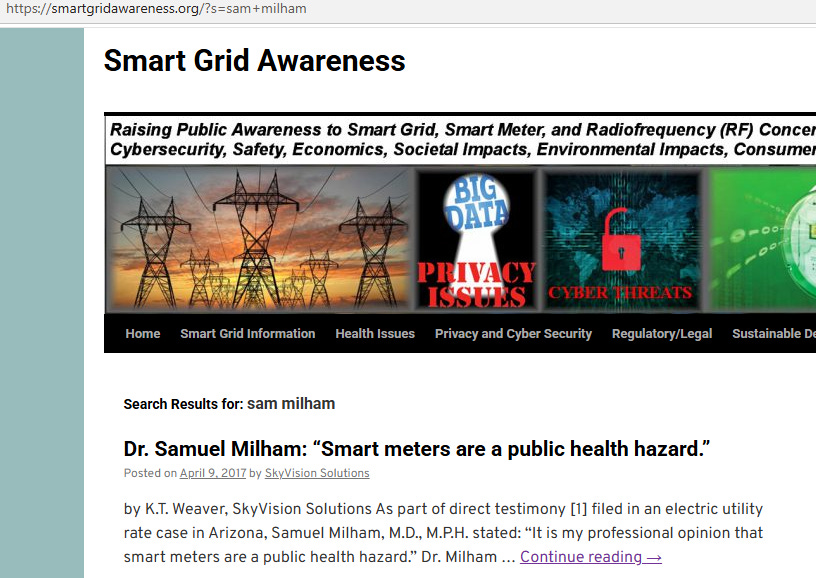
Dr. Samuel Milham: “Smart meters are a public health hazard.” | Smart Grid Awareness
Massachusetts advocates are hard at work attempting to educate lawmakers about the need for a true analogue meter for opt out customers, because RFR is not the only issue.
The industry is reportedly concerned that unless there is a sufficiently punitive surcharge, the technology may not work as designed, especially in a mesh network.
That’s not a good enough reason to ignore the growing evidence of a wrong technology decision that has a foundation, literally, in tobacco science.
“Malicious Data Collectors’
Not disclosing to consumers that their data is being collected is malicious.
Re Data security, Not all Americas saw the news, for example in January 2026 in France: 45M French records leaked after suspected attacker exposed data trove
Key takeaways:
Over 45M French records were exposed in an open database likely compiled by malicious data collectors.
The leaked data included voter registries, healthcare professional records, and automotive insurance information from multiple sources. []
Combining demographic, healthcare, and financial data enables attackers to commit identity theft, financial fraud, and social engineering attacks.
also to rob homes, or to blackmail others?
It’s not just criminals misusing/abusing the data.
“Giving consumers more information about how to use electricity when it is cheaper” could be achieved many other ways other than via electrical pollution and “gold-plating” the grid.
Ratepayers should have the right to decide if they want to opt in to time varying rates, - and carry the costs of the enabling infrastructure - rather than the utilities and regulators continuously focusing on how money the state can claim to spend on clean energy.
The math isn’t working anymore for households underwater due to rising costs to meet essential needs.