
Legi$lative Policy Making, Lobbying, Law Making, and PUC$: and the Beat Goe$ on for Blanket Citizen $urveillance
Early experiments in Surveilled Communities and other “Things that make you go, hmm” We don't call them political "parties" for nothin"

“Things that make you go, hmm” is a lyric from a song by C and C Music Factory
Disclaimer; This post includes information generated with by AI and it ends on a dark note (Epstein) followed by hope
I read something a while back about the energies of this time in history.
The spiritual thought leader noted that some individuals are now going to find themselves in a position where they need to speak out about something, for example an emerging truth that has been suppressed.
Researchers in Pennsylvania note that $441,750 has been making its way into the pockets of the Legislature recently
I thought of this right away when I posted the story of a Legislator in Pennsylvania challenging the narrative of how the prohibition on smart meter opt outs became law in that state.
And also this:
Pennsylvania Smart Meters: Recent Strategies, Handouts. and Whistleblowing... a Rep’s Wife’s EMF/RF/SM Injury In the state described as the most draconian - by law
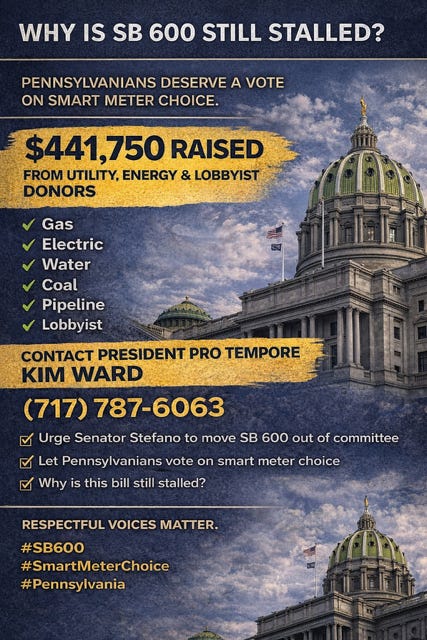
(Pennsylvania’s smart meter policy can be compared to VT’s policy ensuring the right to opt out.)
A few colleagues have noted that the highest “paid” (referring to industry money) legislatures, including those without term limits, are owned by special interests.
SIDE NOTE: Hope abounded when the New Hamshire Legislature quickly produced its 5G report
New Hampshire State Report on Health and Environmental Effects of 5G and Wireless Radiation - Environmental Health Trust
New Hampshire Bombshell Report Documents Scientific Evidence That Questions the Safety of 5G 15 Recommendations Include Reducing Public Exposure to Wireless, Radiation Measurements, Reducing Radiation from Cell Phones and Protection of Trees and Bees
In 2025, New Hampshire legislators receive an annual base salary of $100 National Conference of State Legislatures+1. This is the lowest base salary among U.S. states, and there is no per diem (daily travel or subsistence allowance) for legislators Ballotpedia. People do not do the work for the money.
How Much Utility Industry Money is Running the MA Legislature?
I don’t intentionally use AI, but was grateful when a colleague decided to look under the hood in Massachusetts:
AI Overview
Yes, members of the Massachusetts Joint Committee on Telecommunications, Utilities, and Energy (TUE) receive significant campaign contributions from the energy and utility industry, particularly during periods when major energy legislation is being debated.
Key findings regarding donations to the committee include:
High-Volume Donations During Legislation: In November 2025, as a major energy bill advanced, members of the committee and House leadership received roughly $12,000 in a short period from energy industry groups and their lobbyists, which was noted as significantly higher than in other months.
Key Lawmaker Contributions: State Representative Mark Cusack, co-chair of the TUE committee, has been a major recipient, receiving $4,100 in contributions in one day in November 2025 from industry lobbyists. In that same period, industry donations comprised 60% of his campaign collections.
Broad Industry Support: Contributions come from a wide range of industry interests, including in-house lobbyists for National Grid, Unitil, Liberty Utilities, Avangrid (which owns Berkshire Gas), and oil giant Exxon.
Lobbyist Activity: Lobbyists, who are limited to $200 in donations per candidate annually, frequently contribute to members of this committee.
Influence Concerns: While lawmakers such as Rep. Cusack and Speaker Ron Mariano state that contributions do not influence their decisions, environmental advocates have raised concerns that industry interests have influenced legislation, such as proposals to weaken the state’s 2030 climate mandates.
The TUE committee is considered highly influential, and its members are frequently targeted for donations by companies seeking to influence energy legislation and regulations in Massachusetts. - END (unconfirmed)
Another source: Open Secrets
Proposed State Actions and Utility Commissions
I believe that most ratepayers are not concerned with questions about the decision making concerning their utility meter, or how their utility commissions are staffed.

Image of a revolving door by Sepp from Pixabay, This one is locked when not in use
But the behind-the-scenes question is - how does money and influence flow regardless of the structure?
As citizens begin to question the decisions and the appointment-making process, what actions are being attempted? Can the inquiry move away from politicized rhetoric? It doesn’t look like it yet.
Alabama to End PSC Elections?
ALABAMA Proposed bills would end elected Public Service Commission positions, drawing corruption concerns Lawmakers are considering two bills to replace elected utility regulators with appointed ones, sparking fears of corruption and higher bills for state residents. AND ‘I can’t say’: House Speaker unsure what’s ahead for bill that eliminates elections for utility regulators
Legislation was pulled from House calendar before the session gaveled in Thursday The Alabama House of Representatives adjourned for the week without passing HB392, the bill that would strip voters of the right to elect the Alabama Public Service Commission (APSC), the group that sets your utility rates. You can read more about the bill here.
Georgia to Start Elections to PSC?
GEORGIA State Bill Proposes Elected Public Utility Commission in Georgia A proposed state bill in Georgia would make the Public Service Commission (PSC) — the state’s top utility regulator — fully elected, rather than a mix of appointed and elected seats. The PSC currently has five commissioners, each representing a district, and voters in each district elect one commissioner. The bill aims to ensure that all commissioners are chosen by the people, not by governors or other appointing authorities
FROM NOVEMER 2025 Nine States Face Key Public Utility Commission Elections Ahead of 2026 Key Takeaways:
Rising electricity costs are becoming a major political issue, with rates jumping 19% in New Jersey and 14% in Virginia over the past year, largely driven by data centers and AI demand for power.
Voters in nine states will elect 14 Public Utility Commission members in November 2026. These commissioners directly regulate electricity rates and utility services for millions of customers.
The rising cost of electricity has surfaced in this year’s gubernatorial races in New Jersey and Virginia, where rates have increased 19% and 14%, respectively, over the past year. Much of the country is seeing a similar increase. What’s driving this? Well, as Bill discussed a few weeks ago, “reasons for this are multifaceted and complex,” but one driver is likely to get a majority of the blame: data centers and the AI boom driving demand for them. According to data from the U.S. Energy Information Administration, residential and commercial electricity rates have increased nearly 13% from April 2020 to April 2025.
With energy prices front and center on the voters’ minds, electricity rates will likely be a major factor in 2026’s midterm elections. Yes, we’ll see control of Congress, 36 governor seats, and thousands of state legislative seats up for election next year, but voters will also have a chance to elect members of state commissions that have a direct say in this particular debate: Public Utility Commissions (PUCs). []
On November 3, 2026, voters in Alabama, Arizona, Georgia, Louisiana, Montana, Nebraska, North Dakota, Oklahoma, and South Dakota will elect 14 commissioners to serve on their respective state PUC. Mississippi is the only state of the ten states that elects PUC commissioners that will not hold elections next year. These seats could be particularly competitive if energy prices become a prominent issue, and thus we should pay attention to these obscure down-ballot elections.
- https://www.multistate.us/insider/
Maine - Own the Grid?
MAINE voters considered the ballot question: Ballot question Do you want to create a new power company governed by an elected board to acquire and operate existing for-profit electricity transmission and distribution facilities in Maine?1
Without provocation, co-pilot search AI explained: Maine’s Publicly Owned Utility Grid Plan Maine is moving toward a publicly owned utility grid through a combination of legislative action and regulatory oversight, aimed at giving the state more control over its energy infrastructure.
Legislative and Regulatory Background The Maine Public Utilities Commission (MPUC) has been tasked under Public Law 2021, Chapter 702 to oversee investor-owned utilities’ grid plans every five years, ensuring cost-effective, clean, and reliable electricity delivery www.maine.gov. This process includes stakeholder input, prioritization of investments, and public comment periods.
In parallel, lawmakers have introduced and passed measures to restore local ownership and control of power delivery systems. The bill HP1181 (LD 1646) amends the state’s utility classification laws to include:
Municipal and quasi-municipal entities providing transmission/distribution services.
Any utility wholly owned by a municipality.
A new Maine Power Delivery Authority (MPDA), established in Chapter 40 of the state’s statutes Maine State Legislature.
The MPDA is designed to provide reliable electric transmission and distribution services at the lowest possible cost for the state’s customer-owners, with governance through a board and oversight of utility property and operations Maine State Legislature.
The Publicly Owned Utility Plan The approved plan would seize control of the state’s two largest investor-owned utilities — Central Maine Power (CMP) and Versant Power — through a forced buyout WMTW. These companies are owned by foreign entities (Spain and Canada), and supporters argue the move is about sovereignty and ensuring Maine controls its energy future.
Supporters point to:
97 Maine towns already served by consumer-run utilities saving money.
CMP charging about 58% more than consumer-run utilities in the state WMTW.
Opponents, including some Republicans, call it a “socialist takeover” and question the wisdom of a hostile buyout, suggesting the Public Utilities Commission should address problems without full government acquisition WMTW.
Governor’s Position Governor Janet Mills has expressed skepticism, noting:
The bill covers payment in lieu of taxes to replace the utilities’ $9 million annual property tax base.
She wants more research and analysis before signing WMTW. - END OF COPILOT ANALYSIS
A Few Uncomfortable Questions
How much of the nation’s grid is owned by a foreign entity? (Like UK’s National Grid in Massachusetts)
Why are public utility commissions working on behalf of these for-profit IOU investor-owned utilities with guaranteed rates of return, rather than for the public?
Which states do or do not have a separate independent consumer advocacy group? (ex. TURN The Utility Reform Network in California)? How many of them are still pouring smart meter Kool-aide? Have any of them addressed the FCC’s failure to respond to the 2021 court remand regarding its exposure limits or the issue of polluted power quality?
The Republican Governor and the State of Maine - still talking smart meters in code
The description of Maine’s effort to establish its own grid notes: “If the bill passes, it would create a state-run, consumer-owned utility to manage the grid, potentially integrating with the MPUC’s long-term grid planning process to ensure affordability, reliability, and climate goals are met.”
The Democratic Governor of Massachusetts - still talking smart meters in code
MA Governor Maura Healey noted;
In response to consumer complaints about high utility bills, the Healey administration has responded, in part, by calling for more transparency.
As reported by WGBH in October of 2025, Healey calls for review of energy costs in hopes of avoiding major spikes this winter:
Healey called for the state’s utility regulators to analyze each line of consumers’ gas and electric bills to find charges that can be removed or reduced. Healey told reporters that this would be the first time such a review has been conducted. “Every dollar has to be justified,” she said. “If there isn’t a real customer benefit there, it should come off the bill.”
As posted by Egremont, MA “Reform Rates Customers are experiencing extraordinary “rate shock” this winter, due to a variety of factors, including how rates are currently designed, supply is purchased, and when and how costs to maintain, operate and clean up the energy system hit bills. Governor Healey called on the DPU to investigate and pursue all available opportunities, today, and explore what needs change going forward.
The Healey-Driscoll Administration will propose several options to the DPU, and as part of a legislative package, to make bills more transparent and easier to understand, smooth energy costs by entering into longer, more fixed price contracts, reduce the number of costs that are recovered based on how much you use, provide more options for customers to use energy when it’s the cheapest, and limit how often rates change and by how much.”
This is an endorsement of time-varying rates and smart meters.
It also implies that rather than education and outreach, that the manipulation of the cost of electricity is the path to affordability.
Affordability is a new code word for smart meters
Informed consumers are tracking the game board across the U.S. Policy makers are pursuing the same goal regardless of political party: to create the same smart-metered control grid.
This gets translated, albeit differently, by the two parties and at different times to manipulate public sentiment.
Disaster capitalism is also at play…If the public can be activated
by some localized event like an outage, accompanied by the claim that the meters speed restoration….
or the threat of a gas pipeline to manipulate consumers into believing that the meters will reduce enough generation….
This results in the exploitation of core values of the masses who end up on the wrong side of many policy questions…. and/or who are not aware of the stakes.
Epstein and Surveillance: “military surveillance of civilians”
Manipulating the public so that they support the wrong battles has been the domain of the darkest of human potentials, and this includes the mercenary experts who lie about the intent and the safety, of various agendas.
The sooner that more discernment unfolds, the better.
Several readers forwarded an April 12 post by The Pugilist with Alisa Valdes-Rodriguez.
Generally speaking, I don’t cover the issues pertaining to Epstein.
But the human organism has an energetic pathway known to the Chinese seers that helps ensure our survival, and it manifests a state of disgust.
It works to help us detect spoiled food.
If we smell something rotten, that pathway will deplete our saliva and make other changes in our physiology.
That pathway is still being activated when readers encounter the name Epstein, or a story about the war, or some other story in the mainstream news about a gruesome event.
New Mexico and Epstein, pertains directly to smart meters
Mesa del Sol’s own planning documents describe a development built around “asset tracking, video surveillance, and smart devices” — with a stated goal of creating what the developers called a “safe neighborhood networking solution.”
That’s where Sandia’s interest lay. Smart meters were installed in residential buildings. Granular data on residents’ energy consumption, movement patterns, and daily behavior was collected continuously and is publicly available today on machine learning research platforms. A real-life Truman Show, for military surveillance of civilians.
Sandia National Laboratories — the nuclear weapons facility whose systems Robert Maxwell compromised with backdoored surveillance software in 1985 — was the technical partner overseeing this infrastructure. Japan’s government energy agency invested $22 million in the project. Nine Japanese companies were involved.
The people of New Mexico were sold a hip, cutting-edge residential community.
What we were actually being asked to move into at Mesa del Sol was a federally partnered, nationally significant data collection testbed — built on state trust land, financed with half a billion dollars in public bonds, developed by a company whose founding family appears in Jeffrey Epstein’s files, with the second-in-command of the state’s husband on the payroll. - Source
I remember when I first encountered Paul Harding’s story and about Salt River smart meter pilot program
In 2021 I wrote an article about it for a Father’s Day series published by Natural Blaze, posted here at the Safe Tech International site:
Paul Harding, Total EMF Solutions — Real Men Know That Microwave Sickness is Real: 5G/EMF/RF Father’s Day Stories
June 5, 2021
Despite his warmth and humor, the story made me queasy, for its depiction of human experimentation without knowledge and consent.
This is Paul’s Story. When the Arizona utility company came to install a new digital, wireless electronic meter on Paul Harding’s home 10 years ago, he welcomed it, because he thought that it would enable him to save money. (For those who are not aware, smart utility meters enable time-of-use billing, with peak, off-peak, and other rate schemes, including pre-pay.)
Then, the next morning, he was awoken abruptly at 3:12-3:15 am, “from a dead sleep to 100 MPH.”
When it happened again at the exact same time the next morning, not sleeping, with the smart meter mounted 3 feet from his head, Paul got up and took out his computer. He typed in a search for “smart meter sleep problems.”
“Pilot” Programs? His query took him to Joshua’s Hart’s “Stop Smart Meters” website in California, and from there to the site of Canadian researcher Magda Havas, and the archive of military research papers by Zory Glaser. Paul spent the whole night reading. From that night on, everything in his life changed. At the time, he thought that it all started in February of 2011 with the meter. But he later learned that it started a decade earlier.
Paul began his campaign to get the meter removed from his home by calling the utility company, every day. And, his health was getting worse. He was experiencing numbness in his face and hands, digestive difficulties, tinnitus (which he later learned was microwave hearing), weight gain, and anxiety. []
Salt River Project in Arizona is No Stranger to Smart Meter Technology When the utility contacted him, they had a question for him. “You had a new meter back in 2001, when you were part of the pilot program. Why didn’t you contact us back then?”
And, it was true. In 2009, Smart Energy.com reported, “Salt River Project in Arizona is no stranger to smart meter technology, having been deploying smart metering for over a decade.”
Paul thought back to the wrecking ball that hit his home and his neighborhood years back – his soon-to-be ex wife’s bloody noses, their migraines, the kids always being sick, their irritability, and the impact on other homes in the area, with divorces, health issues including cancers, and early deaths. “No one was well in that neighborhood. They ruined our lives.”
Surveillance in Increasing with the New Generation of Smart Meters
including in MA.
Sleep Disturbance is Increasing
As Massachusetts and other states impose smart meters, others will also be awoken “from a dead sleep at 100 MPH.” It is already occurring due to changes made on the grid, before the meters are even installed. Many changes in the subtle energy body will occur as the result of the inharmonious exposure. Most people have no idea what is happening.
The Action of the Aura and Blood Flow Are Being Altered
Those who are the most aware of the response of the body to electromagnetic poisoning have been outlining how this harm plays out against the physiology of different body types. One universal aspect of the body’s reaction to electromagnetic harm is to collapse the aura. This is another aspect of the subtle energy defense system.
A chiropractor measured this when the documentary film “Take back your power” was made.
Also:
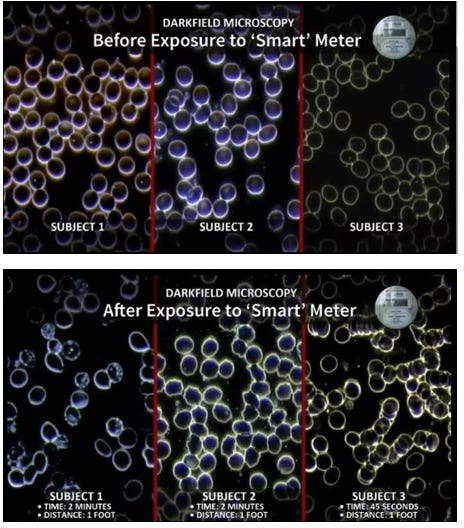
This clip from the film Take Back Your Power shows observable effects of the RF/MW radiation from a Smart Meter on human blood cells using dark-field microscopy. (3 minutes)
More than 5,000 studies now show RF/MW radiation to be harmful to human biology, animals and plants. Acute and chronic exposure to RF (radio-frequency) and MW (microwave) radiation can, even at very low power-densities, lead to not only the negative health effects shown in this picture, but calcium ion damage in cells, endothelial cell dysfunction, nitric oxide depletion, oxidative stress, melatonin disruption, blood-brain-barrier leakage, DNA damage, sperm damage and more. Glucose metabolism changes within the brain are observable after just minutes of cell phone use. The mechanisms for damage from non-thermal, non-ionizing radiation exposure are now becoming clear. - Stop Smart Meters UK (link no longer active)
The new math:
The flow of telecom/utility money into the Legislatures + money into state PUCS
= smart meters + quantifiable harm to health
regardless of whether the PUC is appointed or elected, or which party is in power.
Smart meters do not equal affordability.
This is a bigger issue than data centers and AI.
Telecoms and AI know everything about the Legislators whose votes they seek to control.
A bigger course correction is needed, and more individuals will be facing a choice about truth telling.
Smart meter truth telling is one litmus test for integrity.
The full length film:
We always intend accuracy…If you see an error, please let me know.
excellent article, Patricia, with much food for thought. One tiny error--" ...the FCC’s failure to respond to the 2023 court remand regarding its exposure limits." I think you're referring to the 2021 decision. In August, 2021 "the United States Court of Appeals for the District of Columbia Circuit ruled in the historic case EHT et al. v. the FCC that the December 2019 decision by the Federal Communications Commission (FCC) to retain its 1996 safety limits for human exposure to wireless radiation was 'arbitrary and capricious.'" https://ehtrust.org/in-historic-decision-federal-court-finds-fcc-failed-to-explain-why-it-ignored-scientific-evidence-showing-harm-from-wireless-radiation/